Pages

Showing posts with label community. Show all posts

Friday, May 16, 2014

Border-Crossing Research Update in Syracuse


Open House & Research Update, Syracuse University, May 8, 2014. Short subtitles are included.

A more detailed description of the slides in the video in GoogleDoc
A more detailed description of the slides in the video in PDF
[Right-click to open document in new tab on browser] 

Sometimes, a somewhat ordinary remark dwells longer than it probably should in my mind.

"You like research, right?" Said in the context of new job duties being articulated at my workplace. 

I like doing research, just as I would likely say I like designing, painting, writing, storytelling, and several other things. My "like-ness" level for each of them, however, is slightly different and the nature of each "like-ness" is unique. The commonality among each of them is that these processes allow me to search for, express and synthesize ideas. The process is far more valuable than the outcome.

For instance, in conducting this research study among some Deaf people, I found the language to articulate some of my own struggles as a multicultural person and border-crosser. Who is the "other"? When difference is made visible, how do we handle it? Deaf people taught me to look beyond their mode of communication to see the whole person. Whether a person signs, writes notes or uses an interpreter, an individual is shaped by multiple dimensions. I may specialize in instructional design largely through my formal education and work, but I'm more than that, the sum of many things. For a long time, my Deaf friends were not aware that I was a Ph.D. student -- largely due to my inadequate signing (?) and me not wanting to talk about it when I'm away from my desk, not writing my dissertation. I simply just wanted to be me, Yin, at those intersectional spaces.

I cross intersectional spaces or borderlands (Anzaldua, 1987) everyday and my research interest centers broadly on how people learn and interact at places of change, hybridity and/or liminality (van Gennep, 1908). The above video archives an event that provided me an opportunity to give back to the community in some way by sharing what I had learned from them. The intrigue in doing research is in making connections among ideas and people and being in the intersectional space of change. Whether I write or talk about it, I find joy in sharing what I learned with people.

So yes, I like research, because I like people, ideas and learning. Most of all, to combine elements in an interesting way. The same with drawing, writing, designing, learning something new... Each activity is just another medium I've found and learned to use to express my creativity.

The pursuit of purposeful creative expression (through synthesis) that will make an impact on lives is my true love.

Friday, May 2, 2014

Group Work


It is no secret that students hate group work (Check References). Mazella (2007) summarizes it cogently in his blogpost some seven years ago. Students often encounter unmet expectations and vexations:
  • Equitable contribution
  • Submaximal goal setting
  • Lessened contingency between input and outcome
  • Lack of evaluation
  • Unequal distribution of compensation
  • Non-cohesive group
Though widely investigated, the misery of group work continues to plague courses, UNLESS group work is carefully taught, designed, supported and supervised (Check Maryellen Weimer's Teaching Professor blogpost, July 21, 2008). Just telling students to collaborate doesn't mean they know how to collaborate. And upon graduation, inequitable group or committee work in adult working life persists in lowering work morale. In my life (stress, MY life), I've only seen folks in the corporate world fired for not producing high-quality work in teams.

As an advocate for diversity and respect for difference, I'm not ashamed to say that the brightest and fastest students are held back and under-recognized because one single grade is given to all group members, regardless of the subpar or missing contribution by loafers. I get it, people have reasons that surface unexpectedly for not being able to participate or not being able to perform at high levels. I'm not unsympathetic to the reasons for some members' inability to contribute. But to say that everyone puts their share in the till and the same recognition is doled out equally to everyone is unmotivating. Why should high quality and low quality performance be equally rewarded? Why would an accelerated high-performer want to continue working in that environment? To say that brighter students would be challenged when they serve as tutors to the slower is simplistic thinking. It shows a lack of understanding of the struggles of accelerated learners. They don't always want to be the tutors or the persons whose "brains are being picked" or who are being taken advantage of (Read "I don't want to be a Smarty Anymore). As for the slower students, they don't want to work at an accelerated pace or to "raise the bar." Some students are contented with just "getting by" (Checklist mentality). How then shall the twain meet? 

Suffice to say, group work remains high on the list of problems my clients face in trying to teach online to large classes satisfactorily. And I try to do the best I can to help them as they experiment with solutions and not give up on group work entirely.

This brings me to the inspiration for this blogpost. Recently, I participated in two short group projects for Tina Seelig's Creativity MOOC. Since it's my second time around, I had some understanding of how difficult it might be to work with folks from different backgrounds and time zones. I was hesitant to be in a group initially since I didn't need to stress myself unnecessarily to be involved in unpredictable group work. There is no grade given and I only wanted to enjoy the course.

However, I found myself invited to a few groups. I decided to commit to one. The group problems I had anticipated reared their heads early (self-fulfilling prophecy?). I decided to pull out of the team due to health concerns (working when I should be sleeping and vice versa). But a few team members contacted me and asked me to return. So I relented and rejoined the group.

The problems my group faced were heightened by short assignment deadlines and cross-continental work (India, Armenia, Mexico, USA (East and West coast times)). I could slacken and not put in as much work as I did -- after all, it's just a MOOC! -- but I was working with very young people for who I felt I should model strong work ethic and responsibility. My goal is to help others succeed. This is not a high-stakes course for me but I worked really hard because I could see that most people were trying to do the best they could.

Both group projects involved us having to brainstorm and implement solutions. For our second group project, we had an ambitious goal - rewrite a song, sing the song and spin a story creatively about the solution in less than a week's time. BUT we did it. Not everyone was able to contribute at the same level for various reasons. But I was satisfied that we pulled it off. It didn't matter to me that some were able to put in more work than the rest. I'm still proud of our humble efforts because we had to work against a number of odds. We made it because we were dependent on each other for success!

My next blogpost will outline our efforts in greater detail. 

References

Mazella, D. (Sept. 29, 2007). Why do students hate groupwork? [Blog post]. Retrieved from http://long18th.wordpress.com/2007/09/29/why-do-students-hate-groupwork/

Weimer, M. (July 1, 2008). Why students hate groups. [Blog post]. Retrieved from http://www.teachingprofessor.com/articles/teaching-and-learning/why-students-hate-groups


Saturday, April 28, 2012

Research into Practice: 'Cuse ASL

In mid February 2012, I founded 'Cuse ASL Club with an enthusiastic co-organizer, Corinne Sartori, a Hard-of-Hearing iSchool freshman. I can now say that I've happily passed the torch over to Corinne to lead the club as I prepare to finish off my graduate program. Milestones though, there were several:
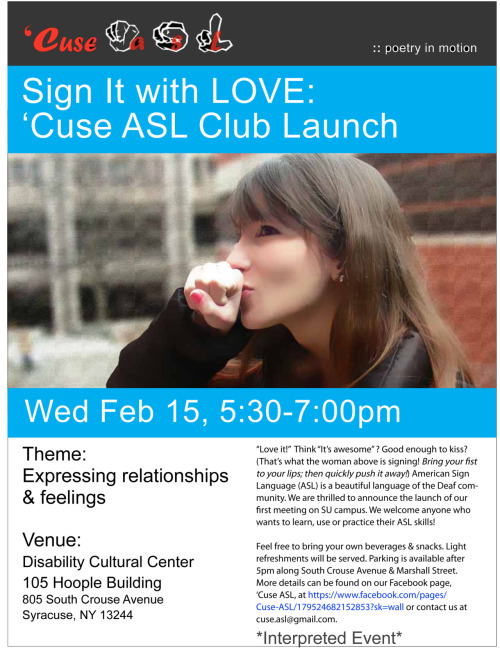
  •  Club launch poster I created with Corinne as model. I was in a hurry and needed someone to help realize my poster concept and Corinne was perfect! She signed "love it" - so apt for an intriguing poster! Corinne does such a great job creating our Event posts on Facebook, you should check them out.
1st Meeting Flyer!

  •  Creating our Tumblr blog http://cuse-asl.tumblr.com/ and having our own Facebook page https://www.facebook.com/CuseASL
  • Finally being able to locate students in SU who signed and were looking for sign partners :)
  • Katelyn, our own member, teaching us to sign an English song, "Follow Me". It was really fun as we tried to figure out which signs were most conceptually accurate.
Katelyn Tamargo teaching members how to sign a song.


  • Going to Chipotle for a club meeting and turning patron heads with our dancing hands!
  • Antonio, Elaine, Jack, John V, Carlton, Chuck and other members of the local Deaf community who came to our meetings and taught us to sign! I made many new friends through 'Cuse ASL.
  • Spreading the news about a great TV series "Switched at Birth" that had hearing and Deaf actors and getting a few members hooked! :)
  • We were featured in the May/June 2012 Siracusa, a publication of the local Deaf community.
Founding 'Cuse ASL brought sunshine (and parallel challenges, of course) into my graduate life in Syracuse.  Being able to translate my current research study into practice: bringing different communities together in a shared -- what they call "third" space/hybrid space -- to learn from one another; wracking our brains to create weekly programs to do so, these were all immensely rewarding to me. I will miss all these when I leave. May 'Cuse ASL continue to flourish!