Pages

Showing posts with label community-based arts. Show all posts

Monday, May 2, 2011

I'm on the Imagining America website!

OK, tooting my own horn, :). Our Access project was highlighted on the Imagining America site because I had the honor to attend the Arts Think Tank on behalf of our project directors! I was at the Next Step in Arts Think Tank:  Using the Arts and Humanities in Community Health, March 17-19, 2011, a regional Imagining America conference, organized with the University of Wisconsin-Milwaukee Center on Age & Community, directed by Dr. Anne Basting.

The theme was on the intersection of culture and health. Read more. On that page, scroll down to find my name to read about our project and our interest in using creative arts to help achieve our goals. R says she's so psyched that our project is associated with this community. Yes! I'm really grateful to have the opportunity to be in the presence of such an awesome group of people. Thank you for sending me there, Mj, R and Mi!

Thursday, March 24, 2011

Next Steps in Arts Think Tank Part 2: Finding Penelope

The Play. I've been postponing this organization of my thoughts and my mixed (in a good way!) response to it. It is a beautifully crafted, complex and tender piece of art. I am half afraid to write about it. But "[f]inding Penelope" (FP) was one of the main reasons for my trip. So I want to document this learning experience.

I had been following The Penelope Project blog for a while after Marj told me about it when she came back from the Seattle IA Conference. It inspired us, me, to consider writing a dissertation about an instructional intervention using theater. To see it implemented in person is surreal.

To provide some background to my perceptions, I've never read Homer's Odyssey as a student in Singapore. My international background may also cause some tension in my response to FP. Asians are expected to show filial piety to their parents, and sending the elderly to "old-age" homes is stigmatized. I struggle regularly with this tension -- being a filial daughter who should be taking care of her elderly parents, one with Alzheimer's and the other one acting as her primary caretaker versus being a supportive wife living in the US. I am conflicted in my response to the cast of elderly participants; I see my mother in them. Would I like to see her in the chorus? I think so. Would I stay away from the nursing home like Mira? No, I don't have the fear of nursing homes that Mira has. But it is a place that is associated with many "de-"s: "decline", "decrepitude", "degeneration" ... except that FP challenges viewers to think differently. Life in elderly care doesn't have to be about waiting for the end to come; we can engage the residents in something meaningful and imaginative. It is certainly not easy. Not everyone is a fearless charismatic leader like Dr. Anne Basting?

I also see among them my deceased friend who was in hospice care in a Catholic nursing home. I've seen her in her final days and remember restrictions were in place for visitors so as not to disrupt her rest. Here, the elderly are participants, opening their living units to us instead of hiding. It confounds my mind in some way -- would I wish peace and rest or clamor for a loved one?

I see talent (Dr. Basting, Sojourn Theater, actors...), hard work, perseverance, collaboration, negotiation, emotional connection... This performance is staged on a scale that is way beyond me right now. Would I love to be part of a project like this? Sure. I miss theater, producing, directing, managing... When can I do it again? I don't know. My dissertation does not include the staging of performances. Perhaps we can continue working with the project somehow to get it to performance stage?

To meet so many theater experts/giants in person was an honor! Other than Dr. Anne Basting, there were Dr. Jan Cohen-Cruz, Gulgun Kayim, Prof. Robbie McCauley, Dr. Elinor Fuchs, Dr. Carrie Sandahl, Prof Lucy Winner, Dr. Susan McFadden, Prof. Raoul Deal, Prof. Robin Mello (actress in FP) not counting other professionals who work in healthcare and arts, Pam Korza, Melissa Sharp and Kirsten Jacobs. I also became acquainted with Leonard Cruz, the choreographer for the gestures.

What an experience! I learned so much from the conversations and thank my project directors for the awesome opportunity.

Friday, December 10, 2010

A Community-Based Theatre Experience

Cry for Peace: Voices from the Congo. Storch Theatre, Syracuse Stage (SS). Last night, I was fortunate to be invited by one of my committee members to watch the poignant documentary-theater, public workshop performance, community-based play (?) about the Congolese refugees now located in Syracuse. It was co-written by Ping Chong and SS dramaturg, Kyle Bass. True, I have used multiple labels in an effort to describe what it is. Still, they are inadequate at conveying what I perceived. Methinks it is a bit of CBP (Jan Cohen-Cruz's model), with a tad more professional input. Cohen-Cruz (2005?) had raised the issue of when the subjects' stories might become the "objects" when reshaped by the playwright. Is it more grassroots or more professionally crafted to make it more appealing to an audience? Nevertheless, this performance was commissioned and developed at short notice. Kudos for using this medium to present compelling stories that might never get heard. This collective action heralds the process for healing and peacemaking.

I had cast those memories out of my mind for some time. Media reports of the horrific Tutsi-Hutu strife were headline news in the mid 90s. These memories were thrust into the forefront tonight. Theatre has a moving way to connect and rouse people's emotions. I was reminded of the significance of my research.

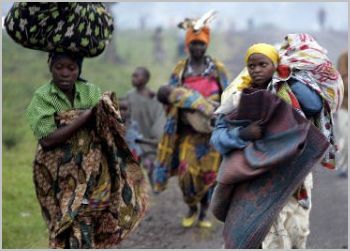
Image source: http://bit.ly/cWDkz3; fleeing the Congo
"Knowing" "creativity" the way I do, I am unabashed to call out creativity when I see it: the use of songs (hymns), gestures (claps), language (French), and people/cast (Belgian-Tutsi lady). All thrown together in a matter of a few months or days (8 rehearsal days to be exact). The talk-back session was curiously bland (cf Boal's style), except when the actors spoke! Only two did and I cannot begin to imagine what it must have been like for them to have to recall the savageness, the barbarism. "Human heads chopped off and stuck in the soil. "Mommy, there is a man growing out of the soil in the field". "They cut the babies out of the women's wombs and made them beat their babies to death" "They cooked those human beings!" Oppressive fear of further unimaginable atrocities had the Tutsis fettered. And all these fueled by boundless human greed for the rich mineral resources of this country - 10% of the world's copper, 30% of the world's cobalt, and a wealth of other derivative metals for consumer products like coltan for cellphone production.

"Hate comes because of fear; my child, just pray to God!" one actor recalled his mom's words to him. Indeed, so many unkind words spoken by people  arise out of insecurity, ignorance and bitterness. John Maxwell wrote that one of the major tests of relationship building is the ability to rejoice and celebrate with others when they triumph. A persistent challenge.

Wednesday, December 1, 2010

Expert Advice on Community-Based Arts

I'm having a lot of fun right now learning and conceptualizing my yes, new study! I've attended a talk on art-based research (See Nov 30 posting). Today, I had the honor to talk to Dr. Jan Cohen-Cruz, Director, Imagining America, author and expert on community-based performance (CBP). That is, on an unforgettable day of rain and snow, making the walk to Tolley Building a wet and slushy one. Nevertheless, still memorable.:)

Marj had recommended I read her book(s). I've started with Local Acts. It documents the historical origins, establishes the field and introduces the principles, methodology and performance structures of CBP. As an amateur in theater productions in Singapore, it's never crossed my mind before how theater/arts can be such a collective grassroots, hyphenated and cultural event, (possibly guided by a professional) at the same time.

Her book engrosses me in many parts. Reading about her positionality(?) vis-a-vis CBP fascinated me. I could make a similar comparison with myself. An avid arts lover and coordinator in a high school, producing amateur productions for national youth competitions, a first encounter with a Deaf student, then my HOH niece going profoundly Deaf, learning ASL in Singapore and Syracuse, and then being on this Access project. I see several parts of my life connecting me to this dissertation interest.  

Dr. Cohen-Cruz was amazing. She shared many website links, names of people to contact and stuff to read up. How incredibly helpful!

Resources to explore:
Project Muse database (I'd always been using Web of Science!)
www.communityarts.net (archived resources, but on Facebook as CAN, which I'd already "liked")
CAN writer John Sullivan
Linda Frye Burnham
Society for the Arts in Healthcare
Center on Age and Community, Anne Basting, U Wisc-Milwaukee
forgetmemory.org
ESTA, Elders Share The Arts, Susan Perlstein, founder
National Center for Creative Aging

So here I go, again, deep diving into new literature! *SSS-PLASH*