Pages

Showing posts with label visible thinking. Show all posts

Sunday, April 26, 2015

Reggio Educators' Training at Sabot Institute

Are you learning forward or backward? ... Do you attend conferences or workshops year after year, yet rarely adjust your teaching or leadership as a result of what you learned? - Frederick Brown, Education Week Teacher
Voila! A Reggio-educator professional development opportunity surfaced in town; courtesy of Jon Becker. I jumped at the opportunity. These events are short in supply.

Event: The 2015 Sabot Institute 

As a visible deliberate action of learning forward, this blog-post is a reflection of my learning experience. I'll try along the way to provide some information about the learning beliefs and values I cherish about the Reggio approach.

1. The environment is the third teacher.


The city, the countryside, and the nearby mountains serve as additional teaching sites. - Loris Malaguzzi 

Idyllic setting of Sabot School
The Gardens at Sabot, Stony Point
The Gardens at Sabot at Stony Point

The children have outdoor learning time. In the woods nearby, they built some simple structures to hold their backpacks together and planted some daffodils.

Learning in Nature, Sabot at Stony Point

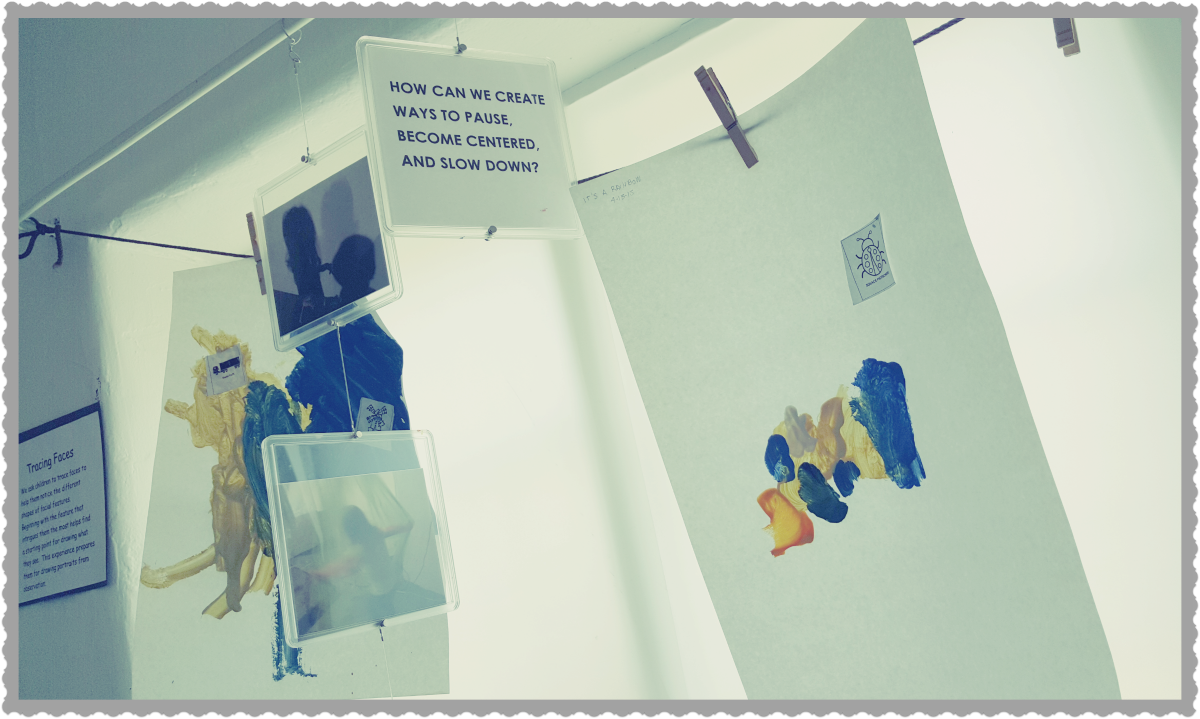
2. "Our walls speak"


Throughout the school, the walls are used as spaces for both temporary and permanent exhibits about what the children and teachers have created; our walls speak and document. - Loris Malaguzzi.
Documentation of children's making sense of light
Documentation of children making sense of light

Documentation of children making sense of materials/paper

Documentation of children making sense of time?

3. "What children learn does not follow as an automatic result from what is taught. Rather it is in large part due to the children's own doing, as a consequence of their activities and resources." - L. Malaguzzi. 


Children shape their own learning experience

Reggio schools have no preplanned curriculum. (Yikes? :)) But this does not mean they start with nothing. Reggio educators use themes to guide student learning. Children are listened to; they shape their mainly project-based school experience, rather than being shaped by any advance curriculum planning or textbook (Edwards, Gandini, & Foreman, 2012).

The Reggio image of a child is...

A child who is competent, a child to whom we must offer many opportunities, so that each and every child can find possibilities for his or her individuality and subjectivity to be expressed, enriched, and developed. (Carla Rinaldi, President of Reggio Children Foundation). 
I saw this concept illustrated and discussed in many of the presentations and workshops. In one hands-on workshop at the Atelier (French for studio), the atelierista (Studio Teacher) gave us a prompt and some inquiry questions. She asked how we would represent the following idea:

  • The teacher forms a connection between the city and the child.

There were about 8 or 9 of us in this workshop. At first, we asked the atelierista some questions which she didn't answer. I got the message. We have to analyze the questions ourselves and come up with our "make" collaboratively.

We tried to doodle on paper what we might want to express. Not used to making things in a studio instantaneously, I decided to just dive in and make as I think. That ended up being our approach. As we each made something with the resources available to us, we found that we were able to build upon each other's "make" (artifact). The final product came together as we saw each one building something and hooked on to each other's ideas. In a very organic spontaneous way, we created something together in the moment.

This is what our model looked like in the end. Using the resources in the city/environment, the child explores and negotiates layers of understanding about the city (hence the wires protruding out).

Group product at the Atelier Studio workshop
Group product after the Atelier Studio workshop

Learning forward, there are many rich nuggets I've collected and continue to unearth as I probe further into this philosophy. I bought 3 books to add to my growing Reggio library. There are too many ideas to share but here are two I'll document in this space. I feel that they connect to a challenge raised by #rhizo15 in the discussion of learning subjectives:

I. Untie the cultural knots we have about teaching and learning (Benjamin Mardell, author/professor, Lesley University)
We tend to think of several concepts about teaching and learning in dichotomies: teaching/learning; theory/practice; curriculum/assessment; individual/group learning; thinking/feeling. [And may I add another pair: art/science.] Mardell noted that in Reggio Emilia schools, these dichotomies are non-existent (Mardell in Project Zero, 2001, p. 282). I am not suggesting that learning science research is useless or that it doesn't matter. Research is important as scholars continue to build upon existing knowledge for future generations. For me, the Reggio approach unveiled more layers about the complexity of learning, one that I continue to be fascinated and inspired by. Since my encounter with this approach, I will share that I don't write learning objectives in my own teaching courses/workshops anymore, if I have my way. I much prefer to explore open questions in a course with learners, including myself.

II. The role of a teacher in Reggio Emilia and implications for my teaching and design.

Although the Reggio approach is originally used in early childhood and in Sabot, applied up to 8th grade classes, it has transferable concepts to learning at higher levels (The core learning principles of Visible Thinking and The Arts and Passion-Driven Learning courses I'd taken in the past are connected in many ways to the Reggio approach). The Loris Malaguzzi International Centre of Reggio Emilia regards the Reggio Emilia approach as

an educational philosophy based on the image of the child, and of human beings, as possessing strong potential for development and as a subject of rights, who learns and grows in relationships with others.
Comparison of traditional versus Reggio educator roles
Text Equivalent of Image (Word Document) 

P.S. Of course, not every teacher is strictly one or the other, as I had written above, but I believe learning in contemporary society, as Reggio schools and children have shown, will become more engaging as we move towards ideals on the right.
Application: My learning goal is to seek to apply some of these concepts in my teaching and design in higher education. 
How will we apply these Reggio Educator roles in our professional contexts?

Tuesday, March 10, 2015

Truthseeking: Onward to the Next #TJC15 event

To Laura, and all potential truth seekers, 

Some preliminary thoughts.

Having read how your experiment first started (the background, your own journal reading club experiences), I understand better why you made the choices you did.

I have had pretty positive experiences of journal article reading with my peers in grad school. In a few classes and during dissertation writing sessions, there were some fine  debates with "a disputatious community of truth seekers" (Donald Campbell cited in Shadish, Cook & Leviton 1991 -- THE Evaluation book every evaluation student must read?). In real life, I've been blessed with some wonderful in-person mentoring experiences through grad school. Leaving those times behind, I often look to replicate these moments -- online and off. Alas, those were different times and a different dissertation topic from yours.

Coming in with those positive experiences, I'm thus of the opinion that reading in advance helped me to learn and participate better (call it learning preference, whatever). I got out of your earlier posts that you are looking for a fresher approach -- the unstructured, unconference, unjournal, un-[insert new approach here] -- which doesn't suggest that older practices may not be good -- which you didn't claim they weren't, at all. I understand now that you are just trying out a new combination of learning conditions to see how learning might work better but differently.  Learning science theories -- I think -- show that designing lessons where the student can be positioned to make as many connections as possible to a new idea helps extend learning. Twitter probably facilitates this, if one can juggle the multiple threads to the same topic. Twitter forgets though that cognitive overload is a challenge for some people. And so, guided instruction may work better for some than minimal guidance.

In the last event, although the frustration of not knowing the content ahead of time and being befuddled -- in my case -- motivated me to go read the interesting article, I wonder how long this ambiguity might sustain interest once the novelty of live-skimming-tweeting wears off or the article is comparably "less" interesting. ;-)) (An assumption probably, since all articles might have to be carefully weighed against some criteria your group has). This is related to Angela Duckworth's research on grit. Do I have the characteristics of grit to overcome the negotiation of ambiguities? Courage, deep commitment, follow-through... to engender intellectual and emotional engagement? So here, the PROCESS of this live-skimming-tweeting experience has an impact on my further engagement. It is also possibly linked to my motivation for participation. For me, it's a fun novel engagement, I've no checkboxes to mark off, no agenda for participating. So, a highly curious question I have for myself: How long would my intrinsic motivation sustain me if the process of constantly negotiating in the zone of change/discomfort/liminality wears me out? My thinking dispositions have held me through many ZPDs, so let's see how this unfolds. :-)

As in every event of complexity, there are no easy answers, what works for one person, may not work for another. I won't have any prepared agenda but I feel my expectation for the next event is somewhat "defiled" with  knowing much more about the origin of this event than I knew about the last event. (LOL)

Like Campbell, I just want to go into new territories and frontiers to interact with new + old people and engage with a "a disputatious community of truth seekers" (Donald Campbell cited in Shadish, Cook & Leviton, 1991). Simple. 

Monday, March 9, 2015

Thinking about Student Blogs and Community Building

Explaining hyperlinked blog concept to client using graphic depiction on a whiteboard
Explaining hyperlinked blog concept to client using graphic depiction
"So you mean we are sharing cyberspace?" 

Seven words that offered a glimpse into our client's thinking. I will refer to her as Ms. Z. [Stan and I met with her.]

Some background information before I continue. She had come to ALT Lab, bogged down by barriers to blogpost-editing and seeking some assistance on how to integrate Timeline into a blogpost.

From her instructor's [Dr. Halo, pseudonym] course site [BEY 500, fake course name], Ms. Z was able to "jump to" and "see" her own blog site. Happily, she has also been blogging on her own in Rampages.us. Yet, how was she not able to edit her own blogposts when she clicked on her instructor's course site and landed on her own blog site? These bits of information gave me clues to her understanding about the concept of mother blog (and student blog) and how things work in an open connected course.

There were some details I clarified with her by drawing out the different entities on the whiteboard:

1. Her blog site and Dr. Halo's course site are two separate entities despite the fact that her blogsite is hyperlinked to Dr. Halo's site. She can access Dr. Halo's course site -- which is also on rampages.us -- via the front door/public view, but she cannot enter from the back end/dashboard view, just as she does for her own blog site. Ms. Z has no control over her instructor's site, she is a student user, not a site administrator. As administrator of her own blog site, Ms. Z can edit her site and create new pages and posts.

Dr. Halo had linked to Ms. Z's blog site (and other students' blogs) using URL links, and not pulling in student content via RSS feed syndication (which Stan and I initially thought was the root of all the confusion). Pulling in students' blogs via RSS feeds would have created the mother blog functionality that I mentioned earlier.

2. Ms. Z wanted to be able to use Timeline and incorporate it in her blog site. Stan explained and demonstrated how Ms. Z could do that, with me chipping in at parts. Ms. Z reviewed the finished product and preferred a more text-based product. Stan suggested using Google Doc instead. After embedding it into her blog site, it still didn't achieve the look Ms. Z wanted. Stan ended up just adding the link to her blogpost.

Ms. Z jotted down notes of our explanations. But one thing that she kept repeating was, "So I go to rampages.us, then under My Sites, look for my blog site, and ..."

I noticed a few striking details:
  • Being able to log in and "do something" on her own site seemed to occupy her mind  considerably. She needed really clear, step-by-step instructions on how to get to her site. 
  • Despite being aware of her classmates' blog sites (they were all hyperlinked to Dr. Halo's course site), she was not aware of what they were writing about or doing until we clicked on one of the blogs and showed her what her classmate was doing. 
  • Depicting the different software applications as separate entities helped her to understand how she would work -- that is, where were the gateways and the sandbox. Not understanding how to gain access stopped her from frolicking in the playground.
  • Ms. Z wanted the demo examples to be left published on her blog although they didn't contain real data. She wanted examples of how things were actually done so she could easily follow the steps when doing things on her own. 
In closing, this consultation raised a few questions:
  • Does aggregating content in a course site create community? The technical structure facilitates community building. But how does community really come about? What makes participants in the community want to check out each other's content and actually connect? 
  • How can we better help students to navigate the sites -- mother blog and student blogs -- so that they can understand the relevance and purpose of these structures and want to engage further? 

Tuesday, March 3, 2015

A Bold Experiment: Live-Skim-Tweet Journal Article #tjc15

Laura Gogia, a.k.a @GoogleGuacamole, my ALT Lab colleague (NOT a Google App as one of my Twitter friends thought!) invited me to her community's experiment to live-tweet reading a journal article. I needed little persuasion because #1. I enjoy Twitter chats and #2. I am highly curious and like to learn new things. It turned out to be a thoughtful learning experience.

There are 2 dimensions about the event I'm going to highlight in this blogpost and a third one I would need to think a bit more about:

1. The Article (pdf)

Personally, one of the big gains of this experience is the article; knowing about it, interacting with the ideas of the authors and with others who read/were reading the article. In this new connectivist learning paradigm, the role of the teacher in MOOCs has been a subject of some private consideration and discussing it openly is progress for the field of open access education.

By themselves, MOOCs do not all fit a simple typology; either as an xMOOC or a cMOOC (Ross, Sinclair, Knox, Bayne & Macleod, 2014). There are "fifty shades of MOOCs" (Just kidding!). Anecdotally, I've participated in several MOOCs on various platforms, and they've been noticeably different to me, even for some of those hosted within the same platform. Suffice to say, as a grand experiment, the various components of a MOOC -- the teacher(s), learners, learning activities, assessment, etc. -- are worth examining. But as the authors rightly indicated, the role of a MOOC teacher -- allegedly a rock-star, co-learner, or an automated assessor of learning tasks -- is nuanced. To downgrade teaching to only "facilitation" (Ross, Bayne, Macleod & O'Shea, 2011) in cMOOCs does not capture the fullness and richness of what teaching is all about, in all contexts. Just as every learner is different and we have Differentiated Instruction, Universal Design for Learning and multiple learning theories to attempt to explain the intricacies in learning and teaching, we need more dialogue on the role of a MOOC teacher. After all, MOOCs don't seem to be disappearing from the learning horizon in the immediate future.

Here are two quick thoughts I have after reading the article:
  • Are MOOCs and online education to be regarded as subsets, one of the other, or do they just overlap along some dimensions? This is significant because at some point, the article appears to suggest a discussion of the role of the MOOC teacher would have some implications for our thinking about the role of the online teacher (pg. 62):
From our earliest conversations as a team, in Spring 2012, about whether we could develop a MOOC, and how this would challenge and refine our beliefs about good practices in online education, this has been a process of critical experimentation. 
My perspective is that online learning can have degrees of in-person teaching components different from most MOOCs. Online education can include blended learning (sometimes called hybrid learning) components with some mandatory in-state residency hours. Online courses can also be crafted using different modalities.  Some are entirely synchronous in nature, and not all online courses are massive, even though they may have large enrollments. When we use the term online courses or online education, they are typically used in reference to institutional online education programs designed to confer specific credentials upon program completion. Although MOOC providers are now experimenting with signature courses with a targeted sequence that leads to specialization certificates, MOOCs and online education are not synonymous.

MOOC participants tend to have significant years of formal education, "just over 60% had post-graduate level qualifications" (p. 63). Most of these students participate in MOOCs to learn something new -- highly motivated non-traditional(?) students -- not to check off a list of program requirements.

The above-mentioned factors may distinguish the role and responsibilities of online teacher(s) from MOOC teachers. What we learn from this article about MOOC teachers may have some implications for online teachers, but I'd comment that the two terms -- MOOCs and Online Education -- are quite distinct from each other.
  • Teacher identity received a fair bit of discussion both within the article and during the Twitter chat. Watson (2009, cited in Ross et al, 2014) singled out three related sites for academic identity -- the department, the institution (Aren't these both the professional sites where a teacher enacts his/her role(s)?) and the personal/professional context. To me, the personal and the professional facets of a teacher's life are entwined and the sum of these experiences shape her teaching and teacher identity. A teacher who says s/he could easily disentangle the personal from the professional in her teaching roles and responsibilities is begging the question, "What makes one a teacher?" I'd say ALL of his/her life experiences, but Parker Palmer would say, [Catherine Cronin cited him in a tweet], We teach who we are (Parker, 2007).  
Like Parker, I ask, "Who is the self that teaches?" because "the human heart-- is the source of good teaching." Many or most educational institutions prize the intellect of teachers, oftentimes neglecting the emotional and spiritual dimensions of teaching, tying academic identity to research accomplishments, less to teaching efforts. Erroneously, not to recognize and support the other dimensions of the teacher's life is to bankrupt him/her; and as Ross et al mention, is to diminish and mischaracterize the teacher. 
Ross et al disclosed the authentic but ambivalent feelings they had as new MOOC teachers: anxiety, excitement and vulnerability in negotiating the newness of the experience. I hope they follow up on the question they posed to MOOC teachers: "How can we provide reassuring and recognizable evidence of our attention earlier?" Not an easy question to answer for sure at a site with thousands of participants, but I feel connection with students trump co-participation and co-learning pedagogical approach. Insert a course introduction video into the course right at the beginning where every MOOC teacher is presented and schedule a Google Hangout ASAP.


2. Doing the Event

I had little expectations for the event and even less preparation. Laura told me I didn't need to read in advance and I'd participated in Twitter chats before, so I thought I was "prepared" for the event. When the time came, I showed up "online," calm but eager to see how it would all unfold. Laura provided some tips for event setup, so I tried to highlight chunks of text for discussion, using Acrobat X Pro and my free Windows snipping tool. Here's the visual for Jeffrey Keefer who asked about the tool:

Windows PC snipping tool on Start Menu of Windows
Windows PC snipping tool

What was unusual about this event is the fact that it was touted as a live reading event. It's somewhat paradoxical for me to read and talk at the same time. Reading is a silent time for me, outwardly. My mind is far from silent, and so the busyness of tweeting, reading (skimming really!) and interacting with other participants was quite a cognitive overload for me (and maybe me alone). In other Twitter chats I've participated in, we were given questions ahead of time to prepare for the chat if we wanted to. There was an agenda set up ahead of time. This live-tweet reading event was rather disorienting for me because of the nature of the reading material. It was rich, complex and full of interesting quotes. As it is right now, in its present format and form, I feel that the pace of Twitter interactions and communication does not do a rich journal-article-reading justice. We did retrieve some gems from the article. We raised a few interesting ideas, but the depth of exchange that I was expecting escaped me. I had expected more from my own history of having participated in journal article discussions in person. (Maybe it is me who needs to change?) Several threads of conversation were going on at the same time; threads I couldn't make sense of because the other participants could be or maybe were talking about some quote or phrase from the article I wasn't present when it began. I recall just pausing at one point and wondering what was going on. Where could I chip in and how do I answer some of these questions posed at me which didn't seem very related to the quotes I had pulled out? Is this my singular experience? How did the other participants who were not involved in the planning of the event feel? Had their previous discussions prepared them differently for this event?

Looking back, a live-read-tweet-and-comment experience might appear to be a rather incompatible combination. But tweaking the event a little could help. For example, reading ahead of time would have helped me tremendously. Maybe preparing some questions and posting it ahead of time would also help guide the discussion so it would feel less kafkaesque, not in the menacing sense, but it would provide some structure to make it less confusing.

This is not to say I didn't learn or benefit from this experience. I did. AFTER the event, I was very eager to read the article in solitude, and with great care, dwelling on the points and reflecting on some of them considerably. The event heightened interest in more attentive reading. I wanted to interact with the ideas a bit more.

I was certainly glad Laura storified the tweets, and we could access them to reflect a little more later. The hashtag also continues to have a life of its own. For me, I'd continue to add to it when it's appropriate and would follow up on some of the suggested readings.


3. What Next?  

I'd participate in another #tjc15 event but I'd read ahead of time. I would highlight quotes for discussion and plan for it with some questions of my own, just so I could have the opportunity to raise ideas that I'd understand more completely in the context of the whole article. Not reading the article in advance means I was just skimming and jumping from a chunk of text to another, and this doesn't situate the meaning of the ideas in the entirety of the whole piece. (I'm grasping at words to try to convey my message!)

But definitely, I'm honored to have participated in this inaugural event and am open to discussing this reflective piece further.

Monday, February 23, 2015

Designing a Course Worth Learning 1

A woman is seated on the floor sorting papers and books, separating essential from nice to know stuff.
Selecting content? 
Over the next few weeks or months, my goal is to reflect on what and how I think as I design (big and small, d/Design) UNIV 291 in the roles of an instructional designer and instructor. There are many design decisions to consider. But there are a few BIG questions I must address. Uppermost in my mind is a question I borrow from David Perkins, a scholar I greatly admire for his ideas on thinking, teaching/learning, and clarity of thought.

With only 8 weeks for a summer online elective course, a big question I have is "What is worth learning?" [If there are things worth learning in a course of study, there are also some things we have to let go of, writes Perkins.]

A related question came in the form of an invitation to have a discussion with graduate students:
How do instructors "select content" for a course? 
Content means different things to teachers who adopt different pedagogical approaches. From the connectivist POV, content is external, constantly changing and interpreted (Larson & Lockee, 2014). In my course, we (my students and I) will build a network of knowledge resources together. One of the ways is to use a Diigo group bookmarking site.

Back to the main goal of my post, my response to the first question drives
  • the core questions I will explore in the course with my students,
  • what I will include in my course sessions (hence answering the second question), and
  • the assessments I will design to gauge what is being learned, or not learned, how students are learning, etc. 
In his latest book, Future Wise, Perkins (2014) describes a scenario where a smart-alecky student raises his hand to ask, "Why do we need to know this?" Therein lies the counterpart (or counterpoint?) to Perkins' question of what's worth learning. Indeed, as instructors, we hope to avert the occurrence of such instances, albeit astute.

As I ponder this key question (what's worth learning), I thought about the more than two decades of formal schooling I've had and what of it has remained in my life.

1. Most of the academic content I've learned are stored in long-term memory. What counts as active knowledge are what I use daily -- some theories, strategies and heuristics I may refer to for design thinking and problem solving.

2. What has lingered over the years and used persistently are skills of reading, writing, thinking (problem-solving, metacognition), communicating, and relating to people.

3. The early years of learning more than one language and culture and of avid reading and journaling have been augmented by specialized learning in my later years of formal schooling. These practices have morphed into and assumed 21st century forms -- blogging and e-reading extend what I learned from my early years. These practices are a result of my metacognitive awareness and responses.

4. In graduate school, certain values and attitudes were reinforced; discipline, parsimony in writing and precision of thought. In the presence of my mentors, I absorbed via osmosis and observation abstract concepts such as their approach to research and teaching. To this day, what they taught and modeled for me are ideas I still implement in my life -- the knowledge and practice of research, scholarly writing, mentoring, teaching, and service.

All these have remained. How then do these disparate thoughts help me in crafting a course that is worth learning? Here are some preliminary thoughts based on my pedagogical approach to teaching and learning:

  • How will I frame the course topic(s) so that it is generative and makes as many connections as possible to what matters in learners' lives?
  • As a thinking-centered course, what context(s) will I set the course in to help them develop understanding of visible thinking and visible learning? Learning doesn't take place in a vacuum (Perkins, 2009).
  • What do I want learners to understand when they finish the course? What do I want learners to get better at doing? What will learners construct an understanding of? (This has been somewhat articulated in my syllabus 1.0.)
  • How will they actively explore, inquire, argue, and construct their understanding of the topic?
  • What topics will the learners build a network of external knowledge sources on?

Let's see how these macro-level questions will guide me further in course design.

Meanwhile, at the micro design level, I've been working on the course site header and trying to pick the best theme, course site layout, and navigation for the site.

Do you think the header works? Till the next post.

Homepage of UNIV291 summer 2015 course


Monday, February 16, 2015

The Making of a Course Trailer


The course trailer is up on YouTube. Although it runs for less than 2 minutes, it entails a tremendous amount of work. Many people chipped in to help out given the tight time-frame we had to churn it out. To them I owe a debt of gratitude. Their names were not mentioned in the credits and I would like to use this space to express my appreciation to them.

Thank you, in no particular order, Alice Westerberg, Suzie Fairman, Molly Ransone, Emma Gauthier, Aditi Jain and Arianna DeCastro (both the actresses), Marcus Messner (and his students), Alana Robinson, Mr. Hunt, the cyclist who rode around the block near Lamplighter Roastery, Lamplighter Roastery for the loan of a Sharpie, Dan Silverman who earlier consented to do a voiceover, and last but not least, Max Schlickenmeyer, the videographer, concept designer, and all the roles he had to juggle to rush this trailer out. I hope this didn't ruin his Valentine's Day.

This is a quick recap of what we did to create this video. In time to come, this documentation might provide insight for future revisions.


1. Concept Design

After showing Max, my new media specialist colleague, a copy of my draft syllabus, we strove to craft a script. Since this course is not a content-based course and centers on the abstract topic of thinking, it was a challenge to consider how best to make thinking come alive.

Max came up with the concept to put thought bubbles above the actresses' heads. It was ingenious! Note, if thinking were that simple in real life, we would have less misunderstanding and better communication! But that was the best way in a video to represent thinking visually -- something which cannot be seen.

Hence, and back to the importance of making thinking visible. Visible thinking helps US to clarify and manage our own thinking; it helps OTHERS to become more aware of what we are thinking. It thus improves thinking and leads to deeper learning.

I'm an advocate for getting ideas out of our head and into some form of external representation to facilitate positive action. I'm also an avid learner of all kinds of strategies that can help individuals and groups communicate their thoughts -- using visuals (text and images), movement, sound, and learning as many languages as you can manage. However, unless you are ready to embrace certain dispositions towards thinking, the practice of visible thinking will come slower to you. I'll elaborate on this in my course. It will be an 8-week elective course for undergraduates offered this June. The course site is being developed, but I hope to get it up soon.


*February 18, 2015: There was also location scouting, which I'd earlier neglected to include. We checked out Anderson Gallery but settled on the VMFA.


2. Scripting and Storyboarding

Since we can't see each other's thoughts, Molly encouraged us to use a two-column table to script our thoughts. As I started writing, Max started to draft the storyboard. Even so, these have to be translated into moving images and edited. The first video clip that came out wasn't the final cut version. Why? Two persons can look at the same script and interpret it differently. And there is only so much that moving images can adequately describe a chunk of written text on thinking. Ever wonder how marvelous movies are in condensing a book into a two-hour film? I am more in awe of such feats now. Think of Austen's Pride and Prejudice directed by Joe Wright.


3. Animation of Still Images (and Photography)


Script, storyboard, character development, animation ...

I don't know how Max did it but all I did was help sketch out some characters and he animated them all -- characters and thought bubbles. He could sketch them all himself, much more elegantly; I'm guessing he entertained my efforts because he was too busy. Incorporating my sketches did provide me with some ownership of the video production process and product.


4. Videography (The Shoots) and Acting

VMFA shoot

Lest I forget, the actresses are amateurs who did us a huge favor. In the live shoot at the Virginia Museum of Fine Arts, I was glad when Molly came along, to hold the equipment (reflector and camera) and at times, to help direct the actresses on how to act.


5. Audio Recording 

Although there is minimal audio in the trailer, there was a part where I did a voiceover to briefly introduce the course. That was completed in our Jazzmosphere recording studio with Emma and Max's help.


6. Evaluation and Feedback for Editing

Several pairs of eyes reviewed it so we could fine-tune it further, including Aditi (who looked at it from the perspective of a student).

Towards the end, we wanted to give greater prominence to the student "who had taken my course" by zooming in on her notes. We weren't able to do that, unfortunately, due to time and weather constraints. We weren't able to reshoot because of poor weather today; inserting it into a scene with a notebook didn't help much either. So, here are the notes by that 'thought-full' student in all its clarity:

Thought-FULL student's notes
PDF version

I once worked in a multimedia company in Singapore in a creative team. This episode reminded me of those days, one of the best jobs I've had in my life, except that I worked in a highly specialized team as an instructional designer/content writer with a programmer, animator, illustrator, project manager, graphic designer and more. Despite this previous experience, there was still something to learn from working with Max and associates. Looking at him shoot POV (Point of View) shots reminded me about empathy in crafting instruction. Max had also invited a cyclist to ride around the block to make the scene less static. All these, and more I cannot detail fully, offered me a glimpse of the workings of an artistic and creative mind. All these learning opportunities filled my mind to overflowing last week, and in a good way!

I'm tired but thankful we made the deadline and probably set a record for producing a course trailer in 5 days, from concept to development. Of course, there is always room for improvement. For me, I was glad when our student actresses enjoyed the shooting process and one of them thanked me for bringing her on this learning adventure. Quite often, it's not about the final product, but the process. I feel privileged to be in a position to add some value to someone's life.


Sunday, February 15, 2015

Bidart Lipsynch and Imagery

[This post is still under construction.]

The last few weeks have been a blur of activities. Does your brain hurt from non-stop mentation? Mine does and did. As Countess Dowager [Dame Maggie Smith] spouts in Downton Abbey,
"All this endless thinking, it's very over-rated!" 
But poetic imagination is not. To the uninformed, I'm learning to use metaphors in poetry writing, hence this Bidart draft. To Randy and my poetry friends, here are my practice drafts:

1) Here's my Bidart lipsynching draft 1. [Homonym: Lamp/Lamb]

Candle with flame burning on short wick
Candle with  short wick
The Poem is a Lamp

L A M P - radiating light in petrifying darkness, erratic
In its glow. As wispy candle burns into stumpy wick,
Or raging campfire the sacrifice of sweet wooden smoke
Gulps, swallows, the black night

Earnest, ardent, the promise of hope, victorious, breaks the hold of the unknown

March 2, 2015 Try:

The Poem is a Maze

M A Z E – as if a tangle that one must unsnarl diligently
Meandering routes, wicked hedges, loopy grids conceal veiled routes to bliss
Real traps, imagined wanderings, criss-crossing this labyrinth


2) Images Draft 1

Young Love at the Cafe 

Pale frostbitten faces
Lean young bodies
Swathed in thick coats - black, grey, and more black
Layers shed, as young dates sit
At gleaming square tables
Knee-high socks in leather boots
Flannel shirts fight with flimsy cotton lace
And chiffon, whips past me
A cold stream slithers down my aching shoulders
Down to my parched finger tips

"Brown sugar coffee!"
The barista shouts, not once, but thrice
Five thirty-five, the monstrous black clock declares
With its stark white hands
Diners, flushed in intimate chatter
Screaming rock music
Piped in, drowns out the java maker. No one
Claims the hot brew
It waits on the steel counter

Searching for a number
Etched in folded steel tags
Will it match mine, or yours
Taut necks stretch, yearning
"Cometbus," "Patterson"?
On round flat metal plates they arrive
Whetting appetites, real and imagined
An au lait all drunk up
The elderly couple stands, screeching metal stools against concrete
Layers up, and departs into the cold


Friday, February 6, 2015

Collaborative Learning Activity: Poetry Writing

We sat around a table with interesting objects we had brought from home. A community of poet wannabes. Or poetry machines, Randy Marshall our chief instigator cheekily called us. He led us to write poems inspired by the stories we shared about the items. A good activity that I could use one day with my students, if Randy doesn't mind.

Poetry writing sharpens our minds and writing. I like the opportunity it provides for us to be precise and playful with words. It is a great learning activity to try in classes. I recommend it highly, not just in literature classes.

Here is mine, slightly edited from the first draft written on Feb 4 evening.

Some of the objects of inspiration: jade cat, brass bell, seagull feather, my red macrame knot

Objects of Interest

A friendship in Beijing
Solidified by a dark green jade cat
"An exotic city," R professed
Her love for that Forbidden City
Swiftly the gemstone transported me to my unspoken grief

"The first one was damaged
The second one stolen"
So a third ring her mother offered
A sparkling aquamarine set in silver
A symbol of T's childhood in Japan

Where has this bottle roamed
Whose lips have pursed against this rim
A chipped whiskey bottle top
Plucked from the grounds of Rappahannock Station
A decade and a half in L's keeping

A brown seagull's feather
From the shores of a Polly Island Beach
She recalled the loudness of the placidity
Life had become too big and clamorous
The ocean could swallow H
Like a hushed hiccup no one knows
Everything will be okay

Soft crystal clear peals
Of a miniature brass bell
With claws and etched with flowers
A gem found at Paul's Place of timeworn treasures
A renewed friendship from M's years in graduate school

I unveiled my dad's prosperity-red macrame knot
Don't weep, I will be brave
"My dad used it as a key-holder"
Words slow and deliberate, I uttered
Him who I can no longer hold
His effects, his assets, my objects of affection


Sunday, February 1, 2015

Reinventing Dissertation Writing for Sharing

On June 10, 2013, I successfully defended my dissertation and officially graduated from a doctoral program in instructional design, development and evaluation. I had grand visions (delusions?) of staging it as a play. Even as I was writing it, I had considered writing it as a play. My advisor finally let me organize it as different acts/scenes in a play but it wasn't written like a play script or in a dialogue format. She asked me if I was ready to be non-conventional. I didn't know what to think at that time. I just wanted to be done with dissertation writing. (You know what I mean, right?) But the 2014 Summer of Major Changes happened and I took some time off to deal with them. Lying around somewhere is the business card of a dramaturg who I planned to work with to write the play.

Journal articles? Conference proposals? I have been mulling over this post-dissertation challenge of disseminating findings for a while. At first, I was quite sure I wanted a book to be written. People need to know about my findings (Really!). Someone recommended I write to a book editor, and I checked out a few, but I didn't follow up after looking at the requirements. I am quite sure I don't want to write a dry academic book. I had written several proposals and presented at a few conferences. But nagging at me are the stories of my participants whose voices have barely been heard. What do I do?

After chatting with my new Twitter friends yesterday from #satchatwc, I have come to some tentative plans to share these findings, beyond waiting for a play to be written and staged. By the way, Tribes the Play was my inspiration. I took a greyhound to New York in December 2012 to watch it a few months before my doctoral defense, riding right into a snowstorm. I wrote a blogpost about the trip and a strange poem about the play.

The minimalist that I am, I try to use as few words as possible to convey my ideas. So they are broadly sketched out here:

Mindmap of plans to share my dissertation findings far and wide. 
In text description, reinventing dissertation writing will include these steps:
  • I will create a new blog site as a repository for the dissertation findings. 
  • The findings will be presented in multiple ways. As I've always wanted to present it as a play or some art form, I will seek to represent the findings using still or moving texts, images, sound and movement/gestures. 
  • I will work with UNIV 291 course students to collectively imagine how to present these ideas. It is an authentic community research problem that we can explore together. I will present these findings to them as a visible thinking product which needs more work. We can work together to solve this particular challenge of disseminating the findings beyond its present academic format. I have to organize my findings to help them work with my dissertation. But a lot of my findings include long narratives of participants. They will do quite nicely for interpretive work (dramatization etc.). 
I'm excited to see what we can come up with together as a group. Interpretive dances, sketches, maps, essays, stories, acting, ... My course continues to take a clearer form and focus. Onward!

Friday, January 23, 2015

Speaking and Not Understanding

After 2 weeks of redoing a web presentation of VCU's ECAR findings, I'm at Round 3 (or more, I forget, after trying to push some data up quickly by redoing charts over and over) -- figuring out what is at the heart of this project, and what we want to show from these findings. I hear a number of words repeated over and over. Here's my depiction of that situation.

In the liminal zone. 
The problem is that the mental model I have about research and dissemination of research findings is sloshing around in the whirlpool of new ideas that I'm yet to reconcile with. I do not understand inductive reasoning and the coding of themes from quantitative data.

In my current understanding, all research starts with a problem question, but now, I have a mass of data and I'm supposed to induce from collected data a problem question so as to "create a story," "construct a narrative," "tell a tale" etc. Yes, I hear you, my dear good-intention friends and colleagues. That is clear to me -- the storytelling part. These words are abstract input that need to be broken down, and operationalized into action, into deeds. Actually, no offense intended, but if anyone mentions another synonym for storytelling or narrative to me, I might have to excuse myself from the conversation. I've looked at the data since November and storytelling is what I've been trying to pursue. 

As I reflect, I find that we are all speaking the same language -- English, but NOT using the language in the same way. They are communicating through their filters of how they see the world. And I'm not making my thinking visible to anyone -- what I'm truly trying to tell them is not conveyed. 

Reframing my perspective, the work as far as I understand myself entails these processes: 
  • Reading the data findings repeatedly to induce themes from 2 surveys that might lead to a general research question or two.
  • Then, when you have a clear question (or two), I can begin to tell a story to the intended audience. 
  • What is a metaphor for the findings? (No, I will never use the phrase "digital natives.") 
  • David McCandless and company are wonderful, but nothing "fancy" can begin until I unearth the questions from the data to reveal what is significant about the findings. The real work. 
I want to soar but I feel like a tortoise plodding on. And I can't afford to be one.

But learning something new and forging new knowledge or a mental model often humbles me and trains me -- to be teachable and be willing to fail forward. Onward. 

Sunday, January 18, 2015

Photowalks

Intricate Gate
Intricate Gate

Doing the Selfie
The above two photos were taken on July 30, 2014, on my first photo safari with my colleagues.

The next 4 were taken on January 16, 2015 with my new colleagues, Emma and Max, with Tom leading. All photos were taken using my Samsung Galaxy phone.

The Throne
I find this throne-like chair that is blocking the doorway curious.

Winter Tree

I have a penchant for snapping pictures of trees -- blooming, withered, snarling. They are easily symbols of life and death.

1005 and 1007
Architecture is another fave subject. "Don't they all look the same after a while?" my husband asks. Not really.

Spire
I could have shifted myself so that the little bit of another building would be out of the picture. But I find imperfection in photos sometimes rather peculiarly endearing and real. I've added another painted layer over the original photo to make it more imperfect, :-P.

New Faculty Academy 1-9-15
Stan and I were there with Tom. I was happy to find that several participants found ALT Lab's services interesting despite the food distraction.

Down the Street Where I Work

I saw with fresh eyes how lovely these houses were to the left of the building where I work. New eyes are good.

Monday, March 31, 2014

Mental Wonderland: Inspiring Hope & Greatness


Before you scratch your head in perplexity, let me say this, "Give this video a chance!"

SEE. THINK. WONDER (Project Zero at Harvard Graduate School of Education).

Two singers rendering a foreign language song can be helpful as an instructional strategy? Yes, please give yourself permission to wonder (three words I'm borrowing from Philip Yenawine's book (2013) which my colleague Enoch Hale highlighted to me). Also, part of the effortful joy of learning new things involves the deployment of grit (Angela L. Duckworth, U Penn, has been conducting studies on grit), "the tendency to sustain interest in and effort toward very long-term goals" (Duckworth, Peterson, Matthews, & Kelly, 2007, cited in The Duckworth Lab, University of Pennsylvania website, 2014).

Tell me what you see-think-wonder when you get some downtime to watch this lovely video. There will be different interpretations. For me, I've been watching this for months and here's an attempt at articulating my mental wonderland, briefly.

I had a powerful visceral reaction. I see two talented singers making beautiful music. I connected deeply with the way they emote the lyrical content. It doesn't matter that I couldn't understand what they were singing initially. Just google and you'll retrieve the lyrics and translation in less than a second (see link further down this post). This video demonstrates magnificently how non-verbal language (gestures, facial expression and tone of voice) can communicate ideas in a compelling way even when the verbal language is unfamiliar to us. The ability to take any topic and convey the the heart and emotions behind it with such intensity and delicacy is the mark of a skilled artist and communicator. And that these singers are.

In a class, I can envisage using this video to stimulate conversation and provoke students into exercising various thinking moves (Ritchart, 2002). Teaching about diversity, multiple modes of knowledge representation etc... This video is a tool with numerous thinking-rich possibilities. I also chuckle imagining how students will react when the lyrics are unveiled (see below)!

I think about a previous part of my professional life where I sang, produced and directed plays. I taught for many years in Singapore. I want to inspire hope and greatness again, something Eric Jensen wrote in response to Larry Ferlazzo's question about teaching. I want to work like that, live like that and ignite students with that. That passion.

I wonder what that pursuit might entail. For sure, there are a few major challenges. But I wasn't brought up to quit when daunted. I was raised to be Filiae Melioris Aevi in a crucible of excellence. (Loyalty to one's alma mater cannot be faulted surely!) Education fulfilled its promise in my life. How can I make that happen for other students?

For a long time, I've been ruminating over two big projects close to my heart. Staging my dissertation and publishing the narratives my participants entrusted to me. I've sat on these 2 projects for 9 months now. It is time to be a good stewardess of those stories my participants have shared with me in the hope that their voices will be heard. I will have to find ways to flesh out that trust.

Lyrics to song with English translation. What do you think they were singing about? :) Were you surprised when you finally found out???

References

Ferlazzo, L. (March 24, 2014). Response: Great teachers focus on connections and relationships [blog]. Retrieved from http://blogs.edweek.org/teachers/classroom_qa_with_larry_ferlazzo/2014/03/response_teachers_must_connect_learning_to_students_lives.html

Pausini, L. & Fabian, L. (2005). La Solitudine [YouTube video]. Retrieved from https://www.youtube.com/watch?v=UR0eXZQD10g 

University of Pennsylvania, The Duckworth Lab. (2014). Research Statement [webpage]. Retrieved from https://sites.sas.upenn.edu/duckworth/pages/research

Thursday, October 10, 2013

Thinking through Art: How Prior Knowledge Paralyzes

4th Figure Drawing Class.

We warmed up with 10 gesture drawings. In one minute, I must capture the outline of the model. It is especially challenging when the model knows multiple unusual ways to contort himself/herself. I struggle to capture the essence of the gesture. The bodily muscles exert themselves in peculiar ways that I find difficult to sketch rapidly. Today, I  also have to learn how to use new tools -- it is Conte Pencils instead of the familiar charcoal pencil or vine to quickly build the "armature" that my teacher requires. I try, probably not very successfully. 


He tells me not to use just lines but to use the conte pencil as a tool to show "mass." He walks around again and offers more feedback.

"Don't draw something from what you previously perceived a human figure to look like. You need to capture the impulse." He tells me not to draw something that looks like a human figure and then try to make little changes to it to fit what the model looks like before me. Aha 1.

"Do you mean to capture the essence? The emotion?" I ask. "Do you want us to emote through our drawing?"

He stops the class to address my questions. "I know this sounds abstract. Have you all seen the Raft of the Medusa?" We shake our heads. We google for it on our mobile phones, which we are typically not allowed to use in the class. We found the painting by Géricault. "What emotions does the painting convey?" Danger, shipwreck, fear ...? 

"Try to capture feelings like these in your drawings. Like what Géricault did." [Not his exact words] On the side, the model says quietly, "It is not about likeness." Figure drawing is not about replicating likeness, but about capturing an impulse.

I feel like I have a bad drawing day, but in learning psychology terms, no matter how bad a day it is, I learn how our prior knowledge causes rigid thinking. Art teaches me to let go and to unlearn so that I can have new ideas. Aha (over and over again!) 2.

"Use your imagination. Look at what is before you, not what you think it should look like." Am I looking? Paying attention?

In a previous class, we had to draw with a paper covering what we were actually drawing. I love figure drawing.


Tuesday, September 3, 2013

The 4Ps of Co-Consulting

... subheading, The Promise and the Practice


My colleague, Stan, and I have been working with two instructors to convert their face-to-face course to a blended course before it is fully delivered online. What makes this co-consulting distinctive in our case are the following key features:

1.    People

There are two consultants in this session interacting with two clients (at times 3!) in real time.   This entails a negotiation of roles and the values, beliefs and behaviors that come with the enactment of those roles.  I am an instructional designer and Stan is an instructional technologist. To some people, these two labels mean the same thing. Our job responsibilities overlap but our foci differ somewhat.  At the risk of oversimplification, Stan’s the technology guru and I’m the pedagogy pro. (In no way does this suggest Stan knows nothing about pedagogy or I’m a luddite.) We have interdependent roles.  

Our clients are passionate about their cause and course. They want to create the best educational experience possible for their students. The group culture is a highly motivating one.


2.    Promise


The promise of co-consulting is:

2 + 2  > 4

Our collaboration with our clients, who are subject matter experts, produces (we hope) a candescent synergy that does not come about through individual consulting.  Keith Sawyer (2007) calls it “group genius” or emergent creativity.

How to make this knowledge visible beyond our small group is something that is frequently on my mind. It will be the subject of another blogpost!


3.    Philosophy

Improvisation or “improv,” as the jazz greats call it, means we adapt spontaneously to our clients’ concerns about course design as the consultation unfolds. It’s a bottom-up approach driven by our clients' needs; nothing is scripted in advance between Stan and I or our clients and us.  Frequently, we cannot predict what design issues our clients might bring up.  Through the unique backgrounds we each have about learning and teaching, we turn tacit into explicit knowledge through our interactions. We co-construct knowledge at each encounter (virtual or in-person) as we externalize and internalize  ideas (Nonaka, 1998).


4.    Practice


Who speaks when, what and how are decisions we make on the fly as the project progresses.  Initially, I took the lead to provide some structure to the sessions. This practice was eliminated when it didn’t work well with our clients.  An increasingly improvisational approach to co-consulting was adopted when we became more familiar with our clients.

Clear and accurate communication is vital to productive consulting outcomes. They are not unique to co-consulting. However, expectations about communication involving 2 consultants are different. What is the protocol and when to speak respectfully without jeopardizing creativity is a process we learn to navigate during each session.

For me, it flows out of the respect for the tacit and explicit knowledge that we bring to our formal and informal consulting sessions.  I try to listen more than I speak. I let my clients’ fully express their thoughts before I comment. I am also not afraid to question to clarify ideas.

One dimension of Visible Thinking (Ritchart, 2002). Image copyright, Kreher, Y. W.
Documenting thinking is a routine act. I practice graphic facilitation during the process. I also capture thinking after each session. I do this not for the sake of recording my efforts. I believe in modeling effective pedagogical behaviors supported by research. I convey my beliefs about making thinking visible for learning engagement.  Modeling provides a bridge for the learner to move from surface to deep learning.

My role in co-consulting is fluid; I wear different hats at different times:

*Facilitator – group dynamics process expert
*Consultant – instructional design and technology content expert
*Coach – support client thinking
*Trainer – support client skills and knowledge development
*Leader – support group effectiveness by diagnosing and intervening in group processes
(Schwarz, Roger M., Davidson, Anne S., Carlson, Margaret S., & McKinney, Susanne C., 2005)

To conclude, four different people with different backgrounds and perspectives have the potential to produce magic. However, sometimes, differences made visible have the potential to derail productivity. This means all of us have to make some adjustments to self and others to foster the production of creative outcomes.